We've sent you an email with a link to update your password.
Reset your password
We will send you an email to reset your password.
What Are Airborne Particles? Sizes, Sources, and Air at Home
Christine Walek
0 comments
On a still morning, a sunbeam crossing the living room shows you a slow drift of specks that are invisible a foot to either side of it. Those specks are the large end of what scientists call airborne particles. Most of the rest are far too small to catch even in direct light.
This guide answers a plain question, what are airborne particles, and then gets practical: how small they get, where they come from, how to read the particle numbers in an air quality report, and which habits at home make a difference as the windows close for the season.
What are airborne particles?
The U.S. EPA uses the term particulate matter, or particle pollution, for "a mixture of solid particles and liquid droplets found in the air." In everyday language that covers a wide range of things: household dust, pollen, pet dander, bits of soil from a dirt road, and the fine particles that come off a hot pan.
Some of them you can see. The EPA notes that particles such as dust and dirt "are large or dark enough to be seen with the naked eye," while "others are so small they can only be detected using an electron microscope." The sunbeam trick works because light scatters off the bigger pieces. The smaller ones are there too; you just cannot pick them out.
How small they get: PM10 and PM2.5
Air quality agencies sort particles by diameter, measured in micrometers (µm). One micrometer is a thousandth of a millimeter. The two labels you will see most often are:
PM10: inhalable particles with diameters that are generally 10 micrometers and smaller.
PM2.5: fine inhalable particles with diameters that are generally 2.5 micrometers and smaller.
For scale, the EPA points to a single hair from your head. The average human hair is about 70 micrometers across, which makes it roughly 30 times wider than the largest fine particle.
A human hair is about 30 times wider than the largest fine particle. Source: U.S. EPA.
So when a weather app mentions PM2.5 or PM10, it is reporting on particles in those size ranges. The labels describe size, not source.
Where airborne particles come from
Outdoors
Some particles are released directly. The EPA lists sources such as construction sites, unpaved roads, and fields. Many more form in the air itself, when gases such as sulfur dioxide and nitrogen oxides react in the atmosphere. Those gases are, in the EPA's words, "pollutants emitted from power plants, industries and automobiles."
Indoors
Indoor air has its own sources. The EPA's indoor particulate matter guidance names cooking, combustion (candles, fireplaces, and unvented space heaters among them), some hobbies, and material of biological origin. Indoor air also carries "particles of outdoor origin that migrate indoors," so what is happening outside your door shows up inside too, depending on how much outside air gets in and how the air is filtered.
Particles start outdoors, start at home, and drift between the two. Source: U.S. EPA.
If you want a closer look at the most familiar indoor particle, our guide to dust and airborne particles covers how dust builds up and gets stirred back into the air.
Reading the air outside with the AQI
For outdoor air, the U.S. Air Quality Index (AQI) is the number most forecasts use. AirNow, the government's air quality site, describes it as "a yardstick that runs from 0 to 500," with a color for each range. The EPA sets an AQI for five major pollutants, and particle pollution, including both PM2.5 and PM10, is one of them.
Two habits make the AQI more useful:
Look at which pollutant is driving the number. A reading led by PM2.5 is about particles; one led by ozone is about something else.
Check the forecast, not just the current reading, before planning a day of yard work, a long walk, or airing out the house.
Everyday habits for the air at home
Beyond the heating and cooking steps above, a few routine choices keep fewer particles drifting around the rooms you use most:
Dust with a damp cloth instead of a dry duster, which tends to send fine dust back into the air.
Run the range hood for a few minutes after you finish cooking, not only while the pan is hot.
Keep a mat at each entry and leave outdoor shoes by the door.
Wash throws, pillow covers, and pet bedding on a regular schedule, since soft fabrics hold settled dust.
On mild, low-AQI days, open a window for a few minutes to bring in fresh air.
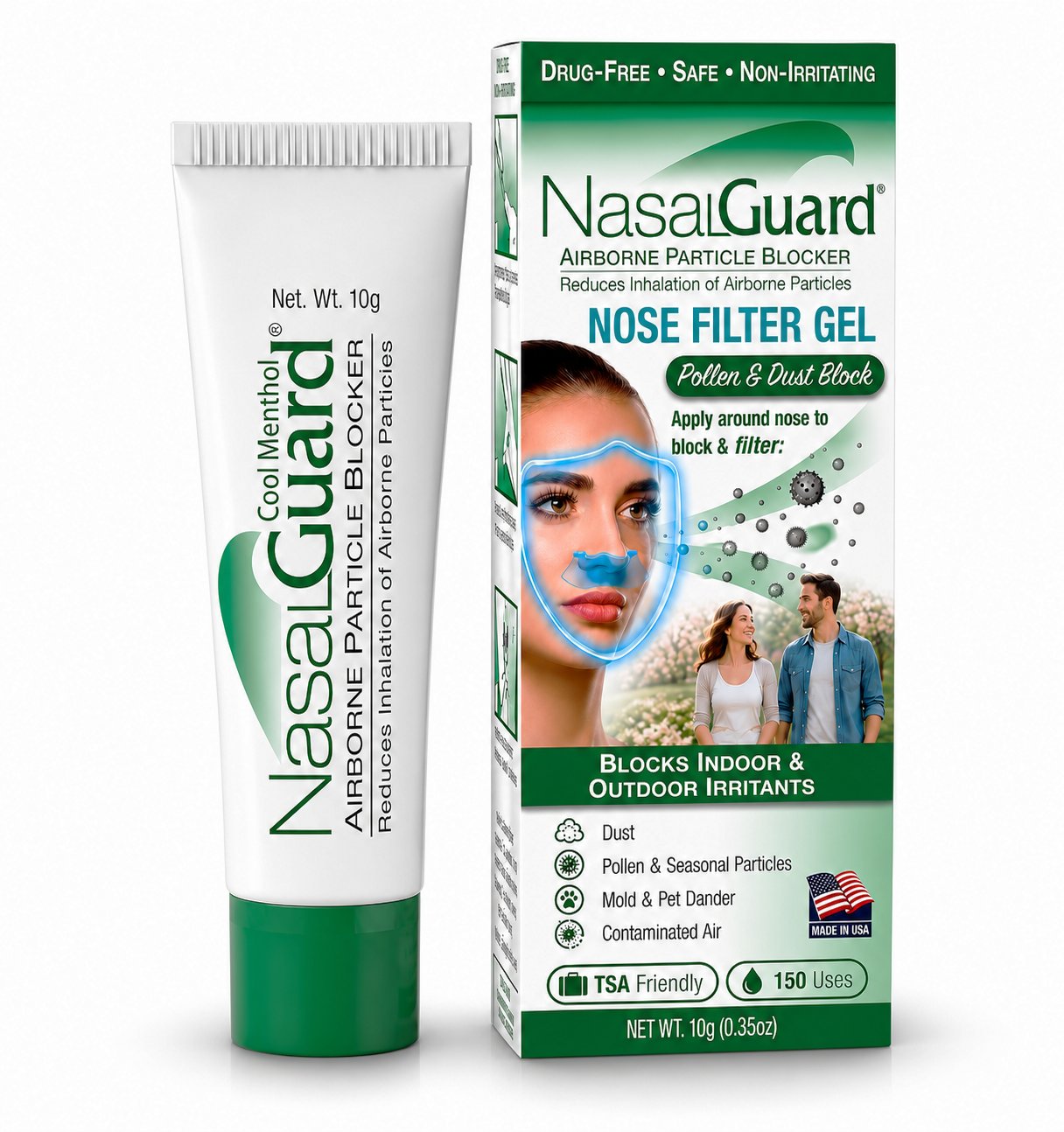
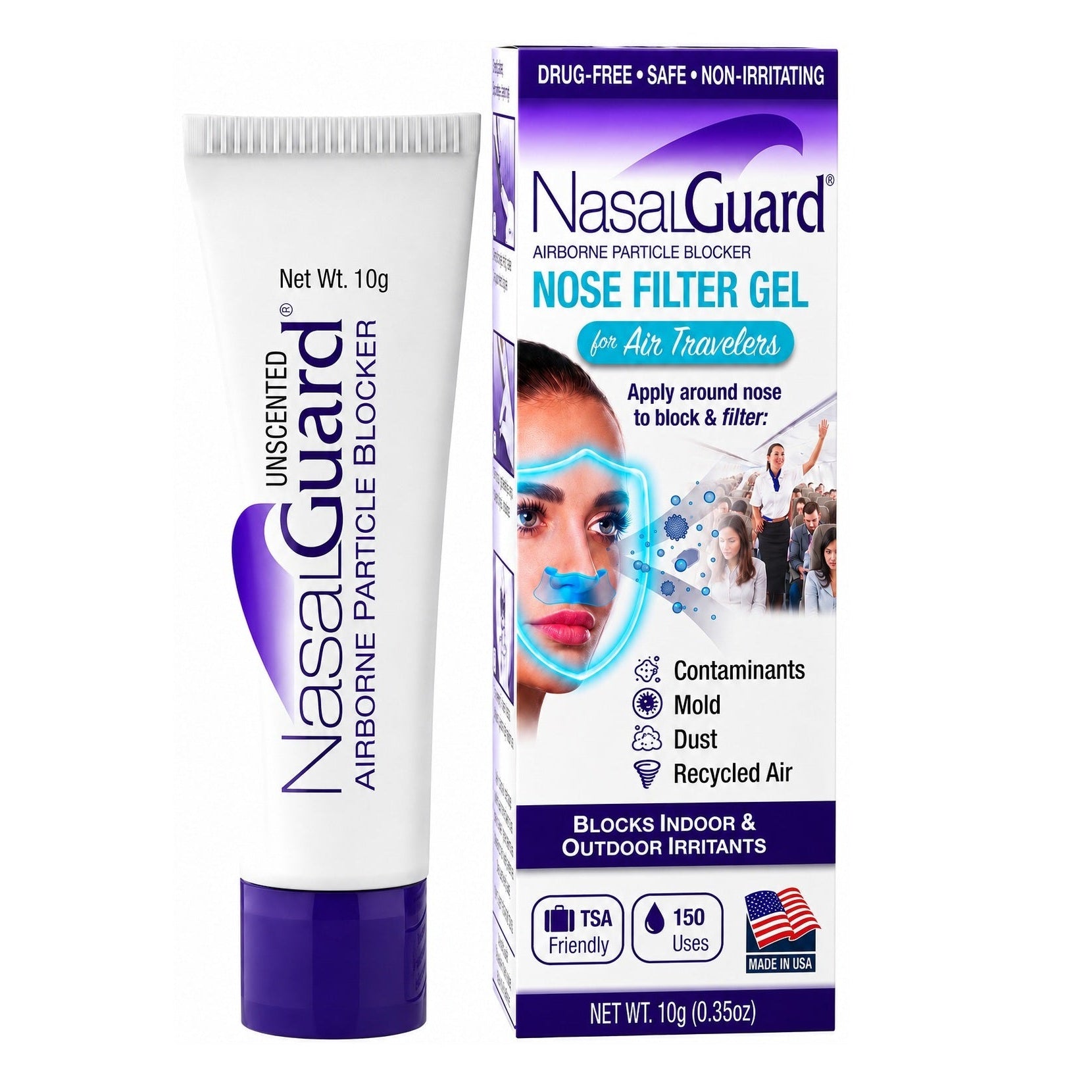
Some people also add a personal barrier step for the times they know they will be around stirred-up dust, pollen, or pet dander. NasalGuard® Airborne Particle Blocker is an invisible, drug-free gel applied around the outside of the nostrils and above the upper lip to help reduce inhalation of everyday airborne particles such as pollen, dust, and pet dander. Use it as directed.
Frequently asked questions
What are airborne particles made of?
Almost anything small and light enough to stay suspended in air. The EPA describes particulate matter as a mixture of solid particles and liquid droplets. At home that includes dust, pollen, pet dander, and particles from cooking or candles. Outdoors it includes dust from roads, fields, and construction, plus particles that form in the air from gases released by power plants, industry, and vehicles.
What is the difference between PM10 and PM2.5?
Size. PM10 refers to inhalable particles that are generally 10 micrometers in diameter and smaller. PM2.5 refers to fine inhalable particles that are generally 2.5 micrometers and smaller. Both labels describe particle size rather than a particular source, which is why air quality reports use them for everything from road dust to particles formed in the atmosphere.
Can you see airborne particles?
Only the larger ones. According to the EPA, particles such as dust and dirt can be large or dark enough to see with the naked eye, which is why specks show up in a beam of sunlight. Many others are so small they can only be detected with an electron microscope, so clear-looking air still carries particles.
Where do indoor airborne particles come from?
The EPA lists cooking, combustion such as candles, fireplaces, and unvented space heaters, some hobbies, and material of biological origin. Outdoor particles also migrate indoors through doors, windows, and ventilation. Venting cooking and heating appliances outside and changing system filters as the manufacturer directs are two of the steps the EPA recommends.
A good next step: open AirNow.gov, look up your area, and check which pollutant is leading today's reading. Then pick one habit from the list above to start this week, before the holiday cooking begins.
Christine Walek writes for the NasalGuard editorial team about air quality, travel, and the everyday airborne particles we share space with. Articles are reviewed against current product labeling before publishing.