It started with
everyday air.

First, pollen, dust and pet dander. Then air travel. Now, a new topical antiseptic product line. Follow the story and the science behind each step.

FOLLOW THE STORYSee the lab results
NasalGuard tube photographed with laboratory glassware and a petri dish

It began with a question.
Could NasalGuard® gel catch pollen?

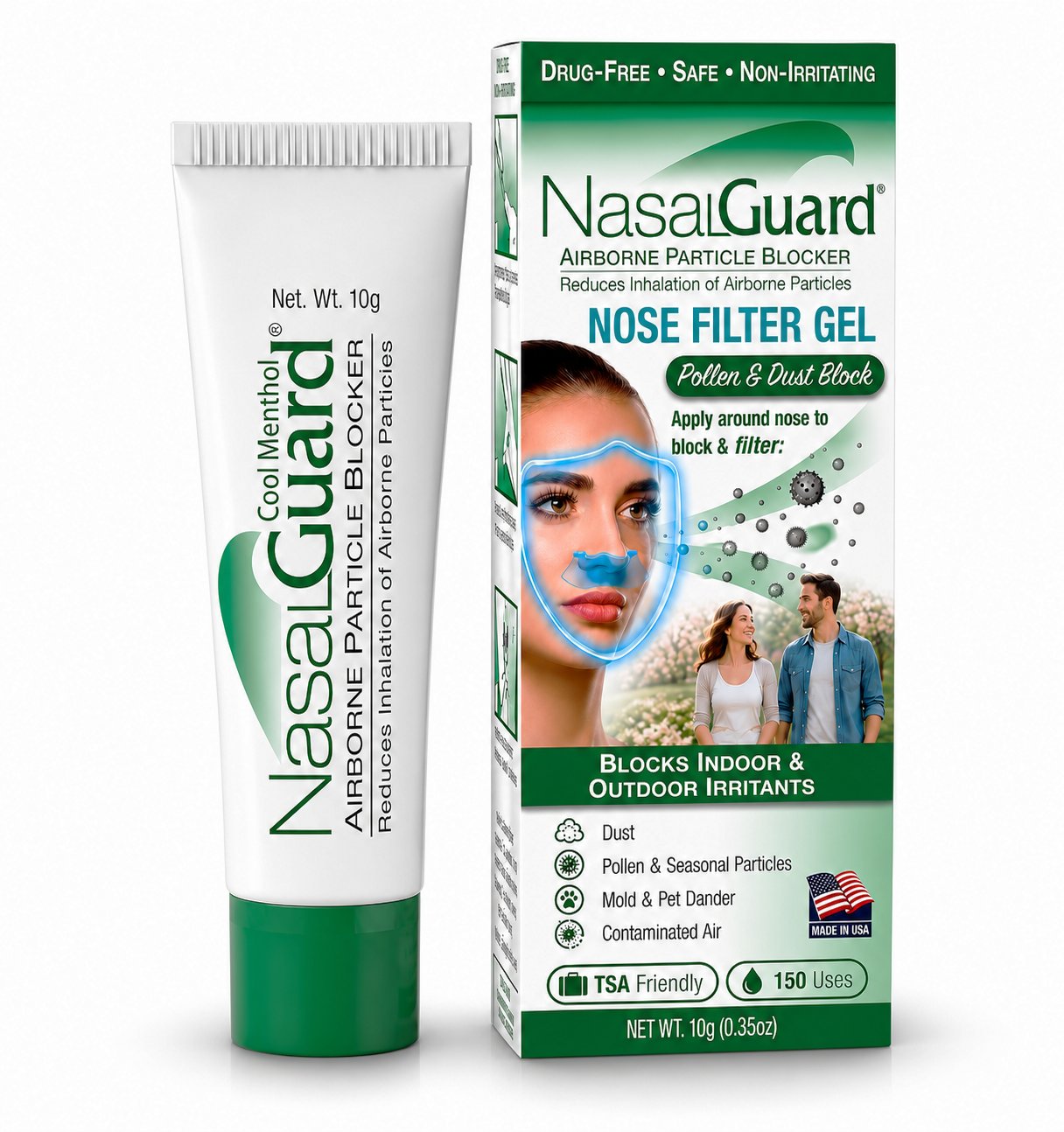
NasalGuard Pollen and Dust Block collage with pollen, dust and a dog
01

First came
pollen, dust and pet dander.

In the early 1990s, reading about electrophysics at Princeton University library gave Ashok Wahi an idea.

Could an invisible gel catch airborne particles?

Robert Wood Johnson University Hospital historical mark1994 pollen-testing letter
3×Pollen CaptureIn 1994, a Robert Wood Johnson University Hospital researcher, Dr. Jinotti, reported about 3 times as much pollen on early NasalGuard® gel-coated slides as on standard pollen-counting slides.10 test occasions. Laboratory slide results.Read the hospital researcher’s report

That idea became the catalyst for NasalGuard®.

Pollen capture was the start.
Next came the question: how?

The early pollen results led to a closer look at NasalGuard® gel’s charge. In 1999, Duquesne University researchers tested parts of that idea.

Schematic illustration of particles attracted toward a positively charged layer outside the nose
Duquesne University logo

Duquesne University
1999 charge testing

Positive Charge
Detected

NasalGuard® gel forms a thin, invisible film around the nostrils and above the upper lip. Its positive charge helps attract and catch nearby negatively charged particles.

Researchers detected positive charge in the tested NasalGuard® gel under laboratory conditions.

Pollen was only the beginning.
Could it catch mold, too?

In 2005, The Asthma Center took the next step: testing NasalGuard® gel’s mold capture. Researchers exposed the coatings to the same air, then counted the spores.

NasalGuardMold-capture results

Mold spores caught

Silicon-gel control

95

NasalGuard

3.8× as much mold as the control
3.8×

As Much Mold
Captured

The NasalGuard® gel sample captured 359 mold spores, compared with 95 on the control gel.

What this shows 359 vs 95 mold spores. About 3.8 times the capture of the silicon-gel control in this slide test.

02

Then Air Travelers
took off.

On a flight, you share a cabin for hours. The air is often dry and partly recycled. Pet dander can also travel on passengers’ clothes.

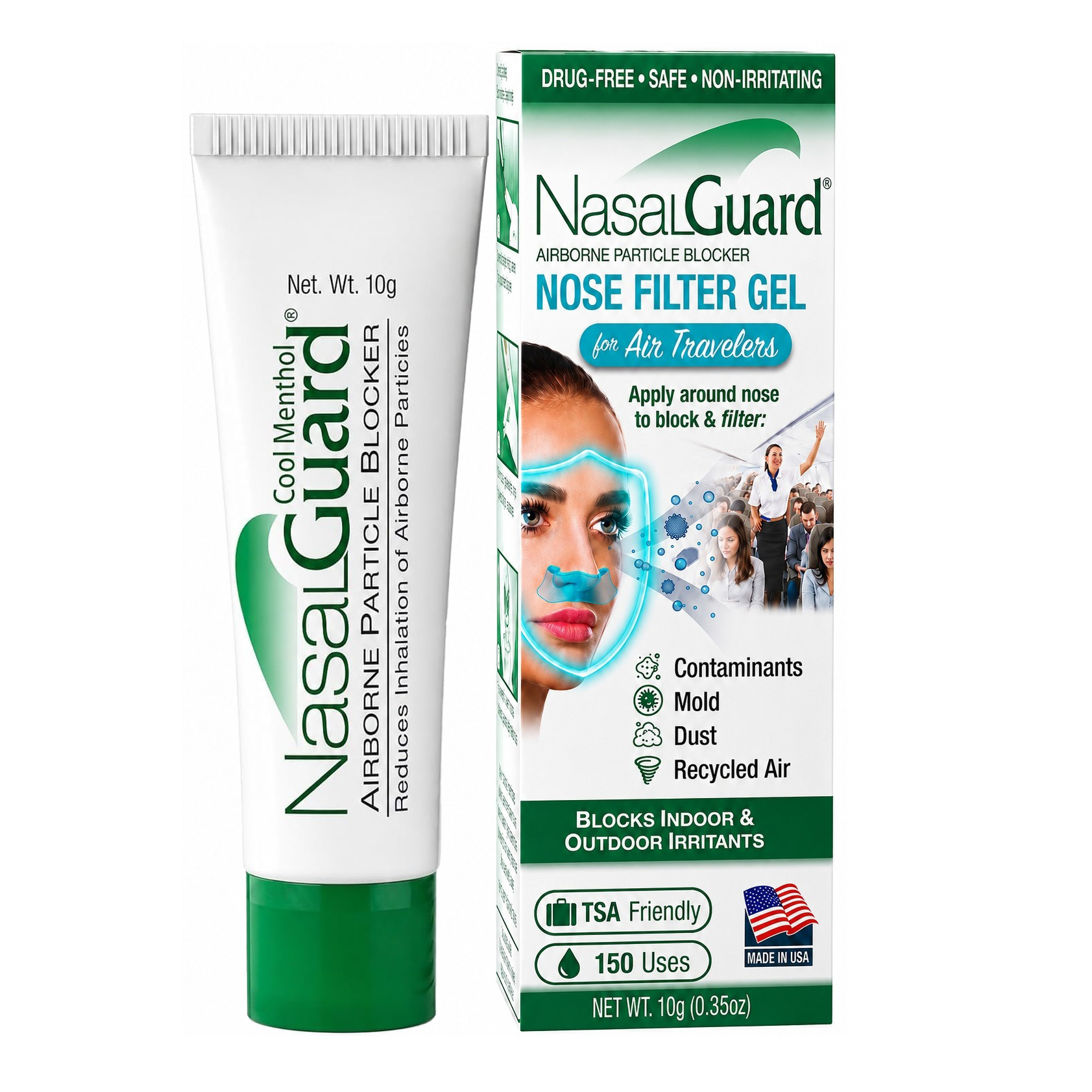
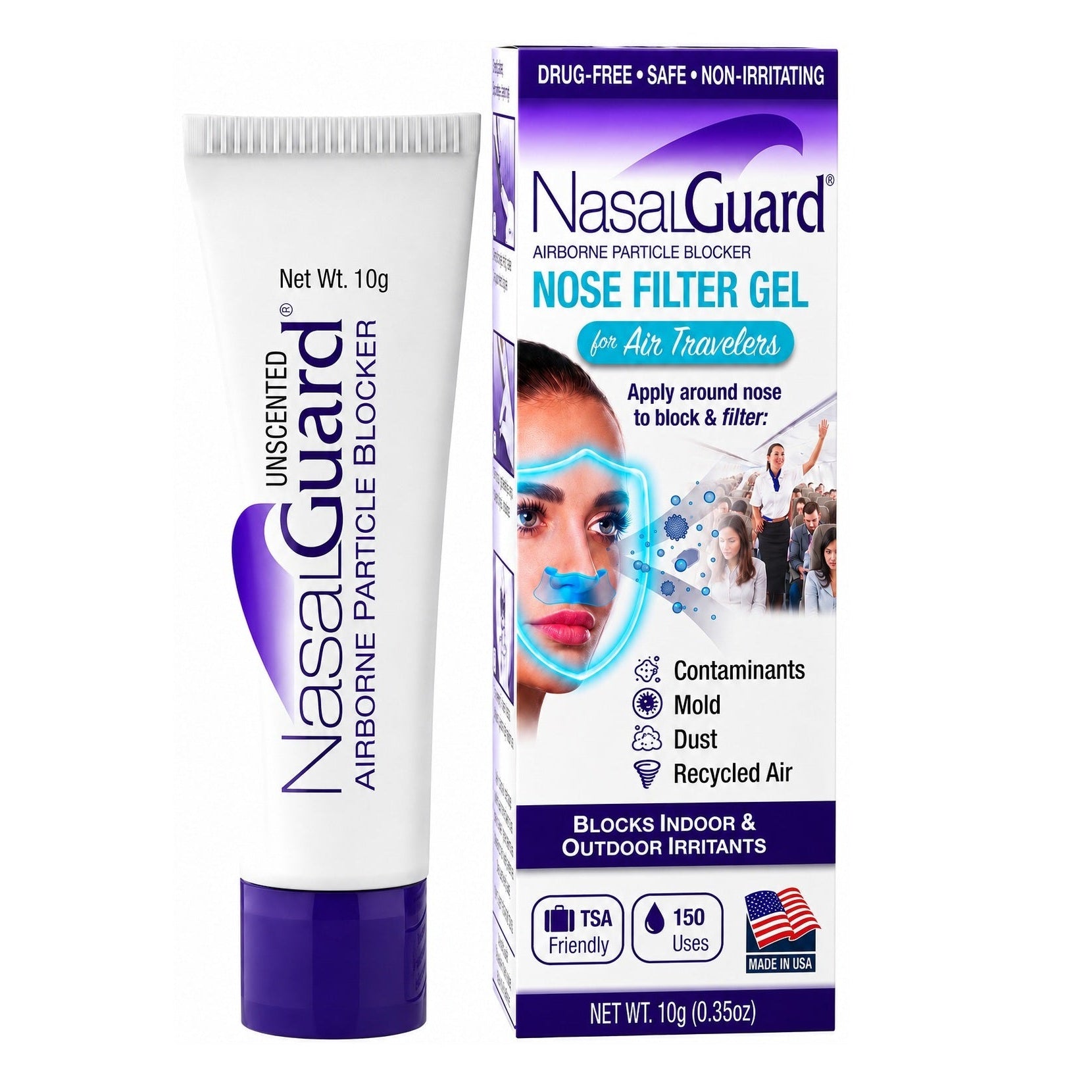
NasalGuard® gel brought the same idea to air travel: help catch floating airborne dust, mold spores and pet dander around the nose.

The lab results showed the idea in action: more particles captured on NasalGuard® gel-coated slides in a 4-hour test.

NasalGuard Air Travelers tube with cabin air vent, passengers, dust and mold

517 with NasalGuard® gel.23 without.

More particles captured.
At all 3 sizes tested.

Illustration of particles collected on a NasalGuard gel-coated slide beside an uncoated slideIllustration

Counts shown: 2.5 μm particles. Average of 3 tests.

Read the study and test details ↓
Stillwell & Gladding Testing Labs historical markStillwell & Gladding
Particle-capture testing
NasalGuard

Particles captured

2.5 μm particles

NasalGuard
517
Uncoated
23

1.0 μm particles

NasalGuard
473
Uncoated
27

0.5 μm particles

NasalGuard
437
Uncoated
27

Same scale: 0–550 particles. Averages from 3 tests. Particle images are illustrations.

Source and tested formula

Stillwell & Gladding, November 7, 2017, Table 1, p. 4. 6 μm NasalGuard® gel coating; four-hour room-dust exposure.

Tested formula: NasalGuard Airborne Particle Blocker.

Travel context: CDC cabin-air guidance · NIEHS pet dander guidance.

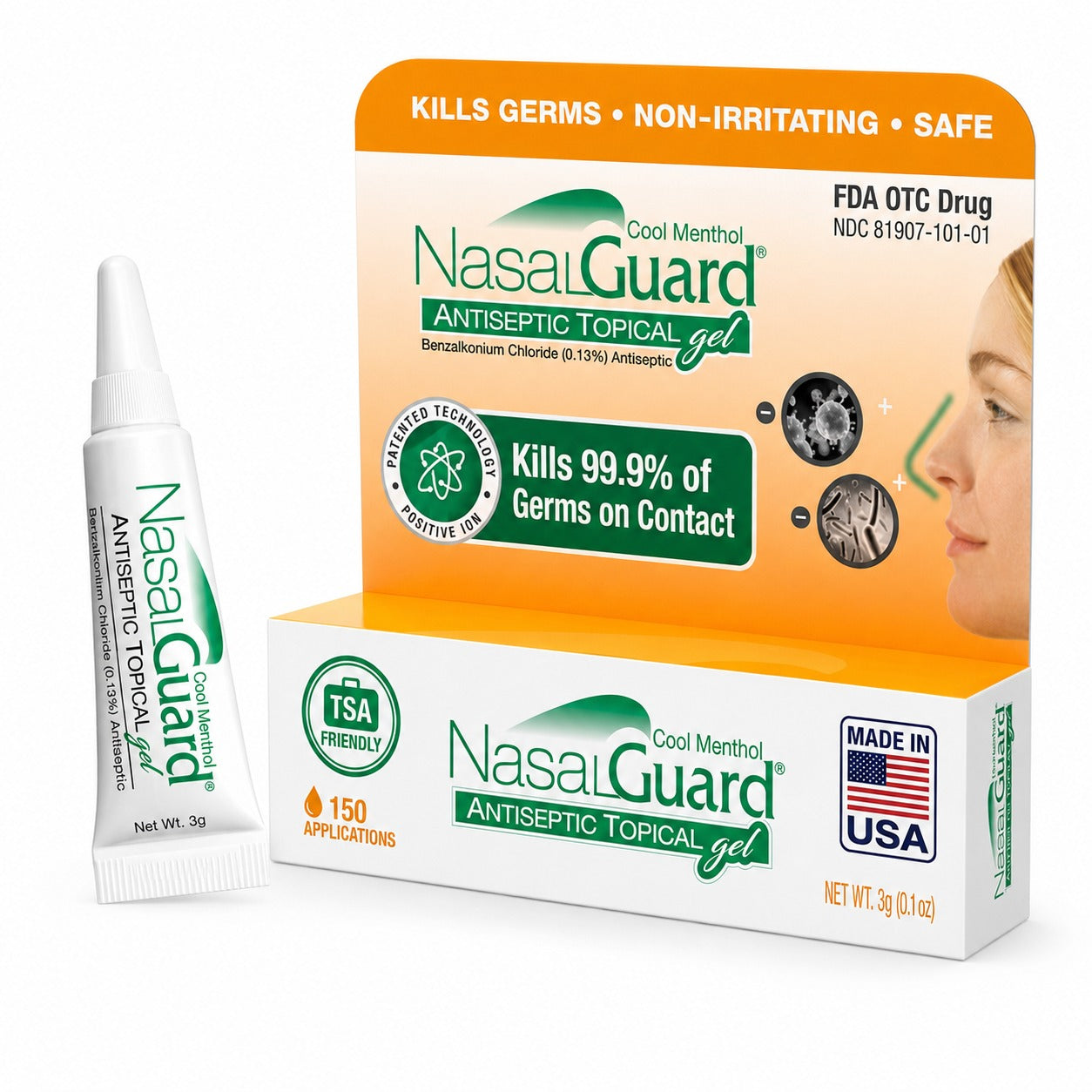
NasalGuard Antiseptic Topical Gel collage with microscopic forms
03

A new line.
Meet Antiseptic.

First, particle capture. Then, a topical antiseptic gel. NasalGuard® Antiseptic gel contains 0.13% benzalkonium chloride to help decrease bacteria and germs on the skin.

04

New formulas.
A commitment to testing.

As the range grows, our goal is to keep testing new formulas. In 2017, a lab rated the tested NasalGuard gel as skin non-irritant.

Skin Compatibility TestedNon-animal testing of the 2017 sample.

Use as directed. Avoid contact with eyes.

Read the skin-testing details ↓
Woman wearing a white coat holding a small NasalGuard tube

Research records

Open a study to see the test, result and limits.

Organization marks identify the source of a specific historical report; they do not imply an endorsement. These studies tested specific formulas. Results may not apply to every product sold today. Some work was paid for by the company. Ask us for the original reports.

Stillwell & Gladding Inc., Testing LabsEfficacy Index of NasalGuard Korea – Fine Dust Filter Gel in Capturing Environmental Particulate MatterStillwell & Gladding Inc., Testing Labs historical letterhead mark

The question: Stillwell & Gladding compared a Korea-specific formulation with IHADA and uncoated slides after four hours of atmospheric exposure under a porch.

The result: Reported means were 473, 370, and 343 particles at 2.5, 1.0, and 0.5 μm versus 20, 23, and 23 on uncoated slides (Table 1, p. 4).

What it means: A different regional formulation. The report’s approximately 17-fold efficacy-index interpretation is not a human filtration rate. Do not transfer it automatically to current US products.

Request the original report ↗
Stillwell & Gladding Inc., Testing LabsEfficacy Index of NasalGuard Airborne Particle Blocker in Capturing Environmental Particulate MatterStillwell & Gladding Inc., Testing Labs historical letterhead mark

The question: Stillwell & Gladding tested three NasalGuard formulas, an IHADA comparator, and uncoated slides. Six-micron coatings were exposed to room dust for four hours, with three experiments per sample.

The result: Airborne Particle Blocker averaged 517, 473, and 437 counted particles at 2.5, 1.0, and 0.5 μm, versus 23, 27, and 27 on uncoated slides (Table 1, p. 4). The IHADA comparator means were 70, 43 and 43. Those comparison results are included in the report; the main chart compares NasalGuard® gel with uncoated slides.

What it means: The report’s efficacy index is not a percentage of inhaled particles blocked. Counts below 0.5 μm were qualitative, not reliably quantified. No human inhalation endpoint was measured. The packet does not verify that the tested formula is identical to every current Air Travelers SKU.

Request the original report ↗
InVitro InternationalEvaluation of Trutek’s NasalGuard Invisible Air-filter Gel SampleInVitro International logo

The question: InVitro International used the Irritection Assay System on Invisible Air-filter Gel batch TTK2017-027 at five sample volumes.

The result: Predicted dermal non-irritant: maximum HIE 0.72. Minimal ocular irritant: maximum IDE 5.5; GHS/EU CLP No Category (report p. 6).

What it means: Predictive acute irritation testing of one batch. It is not a human sensitization trial or a guarantee of no allergic reactions. Avoid contact with eyes.

Request the original report ↗
The Asthma Center · Donald J. Dvorin, M.D.Mold and Pollen Spore Counting Bench TestThe Asthma Center logo

The question: The Asthma Center compared NasalGuard, Alergol, and silicon gel using a Burkard spore trap.

The result: The report described approximately threefold greater mold capture versus silicon gel (p. 3). The appended observation lists mold counts of 359 versus 95.

What it means: The appended pollen observation was 7 versus 12 for the control, so it does not support a uniform pollen advantage. Dates in the schedule and appended data differ. Surface capture is not symptom relief.

Request the original report ↗
Duquesne University · Christianah Moji Adeyeye, Ph.D.Determination of Electrostatic Charge of a Hydrophilic Gel Polymer (Nasalguard) in Semisolid/Solid and Liquid StatesDuquesne University logo

The question: Could NasalGuard® gel’s positive electrostatic charge be detected and measured under different laboratory conditions?

The result: A coulometer detected positive charge; measurements depended on surface, temperature and humidity. The report excerpt found stronger charge than placebo under the stated lower-humidity conditions.

What it means: Supports the electrostatic mechanism. The supplied file includes an excerpt rather than the full charge-testing protocol. Charge measured for up to 12 hours is not proof of 12-hour protection in people.

Request the original report ↗
Robert Wood Johnson University Hospital · Walter J. Jinotti, Ph.D.Pollen Inhibiting Electrostatic Gel : Research LetterRobert Wood Johnson University Hospital historical letterhead mark

The question: A Robert Wood Johnson University Hospital researcher reported testing experimental formulations 19 and 21 against standard slides on 10 occasions.

The result: The letter describes approximately threefold greater pollen attraction overall and gives two examples: 56 versus 14, and 685 versus 167.

What it means: An observational letter, not a controlled human trial. Complete raw results for all 10 occasions and statistical analyses are not supplied. The two examples alone should not become a universal fourfold claim.

Request the original report ↗

Stillwell & Gladding, 2017, Table 1, p. 4. The Asthma Center, 2005, pp. 3, 10–11. InVitro International, 2017, report pp. 2, 6.

Find your
everyday NasalGuard.

Choose the NasalGuard® gel that fits your day.

FIND YOUR NASALGUARD

NasalGuard tube beside a petri dish in a brand still-life photograph