We've sent you an email with a link to update your password.
Reset your password
We will send you an email to reset your password.
Why Dust Sticks to Screens: Static Charge and Particle Sizes
Christine Walek
0 comments
Wipe a TV screen on a dry winter afternoon and by evening a fine gray film is back, thickest right where the picture sits. If you have wondered why dust sticks to screens so fast, the answer is electric charge, and it says a lot about how tiny airborne particles behave.
This guide explains, in plain terms, how a charged surface pulls in particles that carry no charge of their own, and what sizes like 2.5, 1.0, and 0.5 microns look like next to something you know.
What a charged surface is
Most objects carry equal amounts of positive and negative charge, so they are neutral overall. Rubbing two materials together can move a little charge from one to the other, leaving one surface with extra positive or extra negative charge. That leftover charge is static electricity, the same thing that makes a balloon cling to a wall after you rub it on a sweater.
The surprising part is that a charged surface can attract things that have no charge at all. Physics textbooks use a comb to show it: run a plastic comb through dry hair and it can lift small scraps of paper, even though the paper is neutral. The ancient Greeks noticed the same effect with polished amber, which picked up bits of straw after it was rubbed (OpenStax College Physics).
Why neutral specks get pulled in
A neutral speck of dust still has charges inside it. When a charged surface comes close, those charges shift slightly: the side facing the surface ends up with a bit of the opposite charge, and the far side holds the rest. Physicists call this polarization, a separation of charge inside an object that stays neutral overall.
Opposite charges attract, and the pull gets weaker with distance. So the near side of the speck is pulled a little harder than the far side is pushed, and the speck feels a small net pull toward the surface. The same thing happens whether the surface carries a positive charge or a negative one, which is why both kinds attract neutral specks (OpenStax College Physics).
For a scrap of paper, that pull has to beat gravity. A speck of dust a few microns across weighs next to nothing, so even a weak pull can be enough to move it onto the surface and keep it there.
Illustration: how a charged surface pulls in a neutral speck. Source: OpenStax College Physics 2e, section 18.2.
Why dust sticks to screens and plastics first
Screens and many plastics are insulators, which means charge that builds up on them tends to stay put instead of draining away. A screen, plastic blinds, a vinyl chair, and the lid of a plastic storage bin often show a dust film sooner than a wooden shelf in the same room. Dry indoor air in heating season usually makes static more noticeable, which is one reason the film can seem to come back faster in winter.
A few habits keep that film from going straight back into the air:
Turn the screen off before you wipe it, and follow the maker's cleaning directions.
Use a soft microfiber cloth, slightly damp if the directions allow. Dampening the cloth helps keep settled dust from going back into the air.
Wipe plastic blinds and bin lids with a damp cloth rather than flicking them with a duster.
Work from the top of the room down, so anything that falls lands on surfaces you have not cleaned yet.
How small is a micron?
Particle sizes are measured in micrometers, usually shortened to microns and written µm. One micron is one thousandth of a millimeter. An average human hair is about 70 microns across.
Airborne particles can be sorted by size. PM10 covers inhalable particles that are generally 10 microns and smaller. PM2.5 covers fine particles that are generally 2.5 microns and smaller. Some airborne particles are large or dark enough to see with the naked eye, while others are so small they can only be detected with an electron microscope.
2.5, 1.0, and 0.5 microns, side by side
These three sizes come up often in particle research, including the lab results described on the NasalGuard How It Works page. All three sit inside the PM2.5 group. Set against a 70-micron hair:
2.5 microns: the top of the fine-particle group. A hair is about 30 times wider.
1.0 micron: a hair is about 70 times wider.
0.5 microns: a hair is about 140 times wider.
You cannot see any of these one at a time. The gray film on a screen is a crowd of particles in many sizes, packed together until they show. When a lab result counts particles at 2.5, 1.0, and 0.5 microns, the counting was done with a microscope or an instrument, not by eye.
Particle sizes next to an average human hair. Source: U.S. EPA (hair size); width ratios are simple arithmetic.
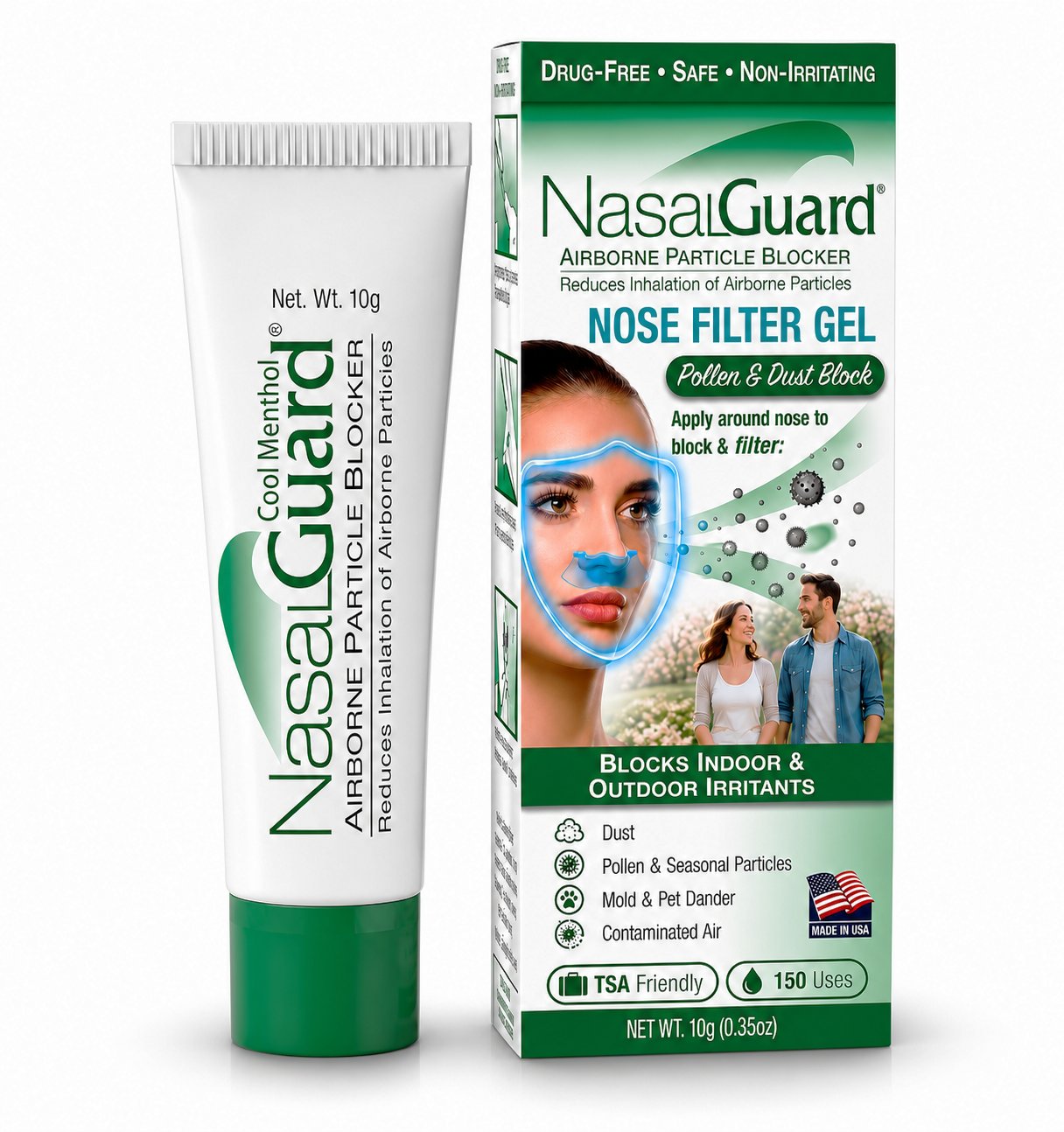
A similar question, whether an invisible gel could catch tiny airborne particles, is where NasalGuard started. NasalGuard® Airborne Particle Blocker is an invisible, drug-free gel applied around the outside of the nostrils and above the upper lip to help reduce inhalation of everyday airborne particles such as pollen, dust, and pet dander. The NasalGuard How It Works page explains its positive ion technology and walks through the laboratory slide results behind it, with the limits of each one. Use it as directed.
Frequently asked questions
Why does dust stick to my TV screen?
Screens hold static charge, and a charged surface pulls in nearby dust specks even though the dust itself is neutral. The charge shifts slightly inside each speck, so the side facing the screen is drawn toward it. Dry indoor air tends to make static more noticeable, so the film often returns faster in heating season. Turn the screen off and wipe it with a soft microfiber cloth, following the maker's directions.
How big is 2.5 microns?
A micron is one thousandth of a millimeter. An average human hair is about 70 microns across, which makes it about 30 times wider than a 2.5-micron particle. A single particle that small is invisible to the naked eye. You only see fine particles when many of them collect together, like the gray film on a screen or a shelf.
Can a charged surface attract a particle with no charge?
Yes. A neutral particle still contains positive and negative charges. Near a charged surface, those charges shift so the side facing the surface carries a little of the opposite charge. Because the pull is stronger at shorter distances, the particle feels a small net attraction. This works with a positively or negatively charged surface, which is why a rubbed comb can pick up neutral scraps of paper.
What does PM2.5 mean?
PM2.5 is the term for fine particles that are generally 2.5 microns and smaller. Particles of 1.0 and 0.5 microns are part of that group. PM10 is the term for inhalable particles that are generally 10 microns and smaller. The numbers describe particle diameter, not how many particles are in the air or where they came from.
Next time the screen goes gray, switch it off and wipe it with a soft, slightly damp cloth, working from the top of the room down. Then, if you are curious how the same physics shaped a product, read the How It Works page.
Christine Walek writes for the NasalGuard editorial team about air quality, travel, and the everyday airborne particles we share space with. Articles are reviewed against current product labeling before publishing.