We've sent you an email with a link to update your password.
Reset your password
We will send you an email to reset your password.
Dust Particles in the Air: Why You See Them in a Sunbeam
Christine Walek
0 comments
Around four o'clock on a late-November afternoon, the sun comes in low through the living room window and lays a bright stripe across the room. Inside that stripe, specks drift, turn, and flash. Step out of the beam and they seem to vanish, but they haven't gone anywhere.
This guide explains what makes dust particles in the air visible in a sunbeam, what those specks are made of, why many particles never show up at all, and how to use that low afternoon light as a free check on your cleaning routine.
What you are seeing inside a sunbeam
Light travels in a straight line until something gets in its way. When sunlight hits a floating speck of dust, part of that light bounces off in new directions, and some of it reaches your eyes. Scientists call this scattering. For a moment, each speck becomes its own tiny point of light.
Two things make the effect easy to see indoors. The beam is bright while the rest of the room is dimmer, so lit specks stand out against a darker background. You are also usually looking across the beam from the side, which is where some of that scattered light is heading.
The same thing happens outdoors on a much larger scale. NASA's Earth Observatory describes how sunbeams breaking through gaps in clouds become more clearly visible when dust is suspended in the air, and ties these rays to a low sun angle near sunrise or sunset. The stripe on your living room floor runs on the same physics, just across a few feet of air instead of a few miles.
Illustration: a floating speck scatters part of a sunbeam toward your eyes. Source: NASA Earth Observatory.
Why you notice it more in late fall and winter
Nothing special happens to dust in November. What changes is the light and the way we use our homes.
The sun stays lower in the sky through the day in late fall and winter, so its light comes through windows at a flatter angle and can reach farther across a room.
Windows stay shut, so the beam crosses still indoor air rather than a breezy patch near an open window.
Heating season means more time indoors, more blankets and throws in use, and more chances to stir up what has settled.
If you only notice the sparkle a few months a year, the low winter light is the likely reason. For what happens when the furnace first switches on, see heating season dust.
What the specks in the beam are made of
Indoor dust can be described as settled particulate matter from a variety of sources. The list of what indoor dust may contain includes:
outdoor soil and dust blown or tracked inside
pollen and pet dander
human skin flakes and hair
particles from cooking, cleaning, and burning candles
particles from consumer and personal care products
The mix shifts from home to home. A house with a dog by the back door and a stack of wool throws will hold a different blend from a small apartment with hard floors and bare windows. The beam can't tell you which particles are which. It only shows you that something is floating, and roughly how much is moving at that moment.
Some of what indoor dust may contain, per the U.S. EPA's Sources of Indoor Particulate Matter page.
The dust particles in the air you can't see
The specks that flash one by one are the larger ones. Plenty of airborne particles are far too small to show up as individual points of light.
Some particles, such as dust and dirt, are large or dark enough to be seen with the naked eye, while others are so small they can only be detected with an electron microscope. For scale, the agency compares fine particles, called PM2.5 and generally 2.5 micrometers and smaller, with a single human hair. An average hair is about 70 micrometers across, which makes it 30 times larger than the largest fine particle. PM10, the larger inhalable group, is generally 10 micrometers and smaller.
So a sunbeam gives you a partial view. A stretch of air that looks empty outside the beam still carries particles, and a beam with only a few specks says nothing precise about the finer ones. If you want the full size picture, what are airborne particles walks through the classes and where they come from.
Why dust floats instead of dropping straight down
Small, light particles fall slowly, and the gentle air currents in a room are enough to keep them drifting: a heating vent, a person walking past, warm air rising off a sunny windowsill.
NOAA gives a sense of how much size matters in the open atmosphere. Dust particles with radii between 0.1 and 1.0 micrometers can stay aloft for 20 days or more, while larger particles with radii of 5 to 10 micrometers usually fall out of the sky within 24 hours. A living room is very different from the open sky, so those numbers don't carry over indoors, but they show why size changes how long a particle lingers.
Indoors, the bigger factor is what puts settled dust back into the air. It can easily be kicked up by cleaning, vacuuming, and everyday movement such as walking. Shake out a throw blanket in a sunbeam and you can watch that happen in real time.
Use the sunbeam as a free dust check
The next time low light hits the room, try this. It takes about five minutes.
Look at the beam while the room is still and note roughly how busy it is.
Walk through the room, sit on the couch, and fold a throw. Look again.
Dust one surface with a dry cloth and another with a damp one, then compare the beam near each.
Run the vacuum, wait a few minutes, and check once more.
The comparison is rough, but it shows which of your own habits send the most dust back into the air. Then adjust using everyday indoor dust habits:
Dust often with a damp cloth. The agency notes that dampening the cloth helps keep settled dust from going back into the air.
Vacuum carpets and upholstered furniture every week, or more often.
Consider a vacuum with a filter, which can help keep some vacuumed dust from escaping back into the room.
Change portable air cleaner filters according to the manufacturer's directions.
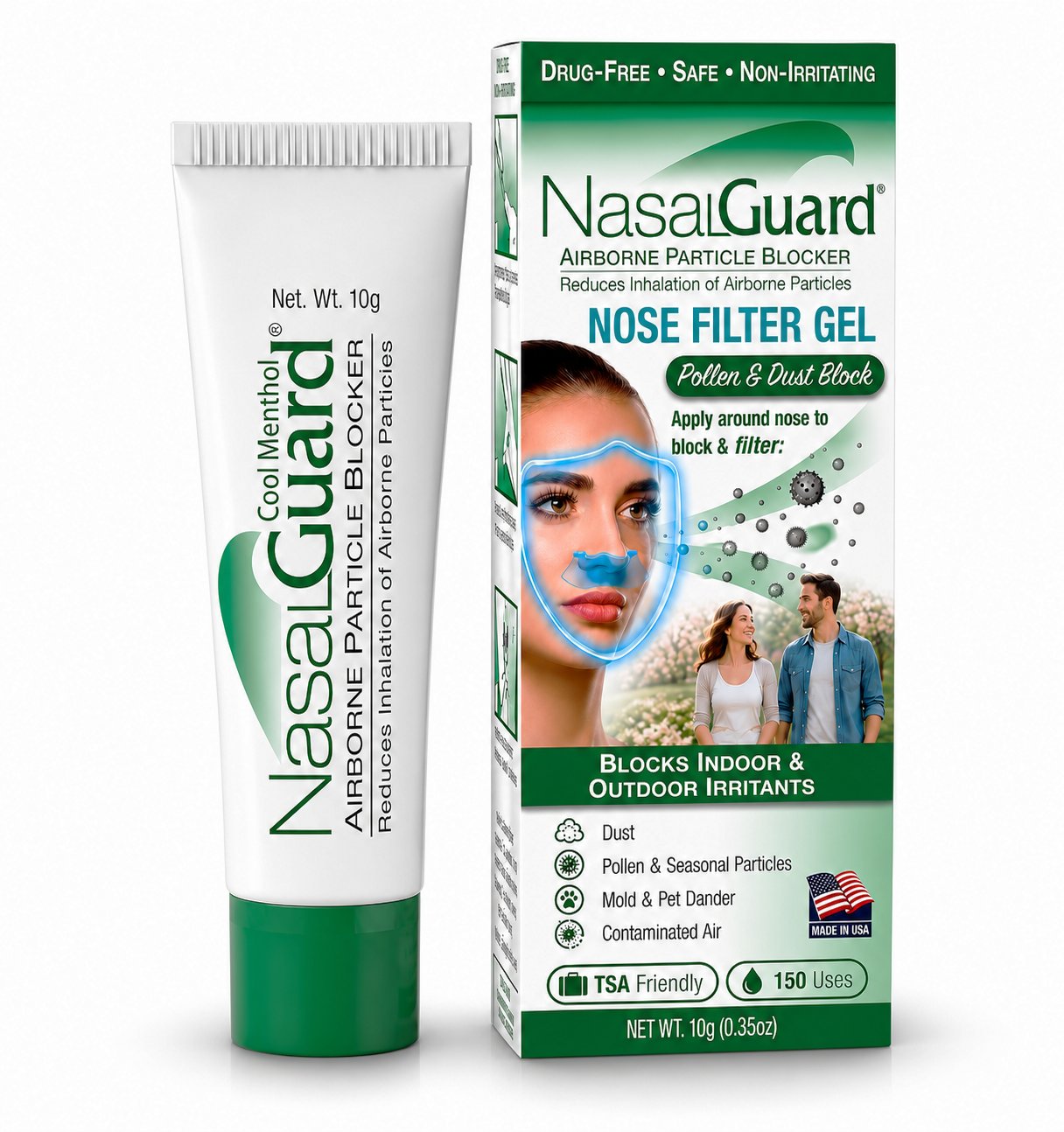
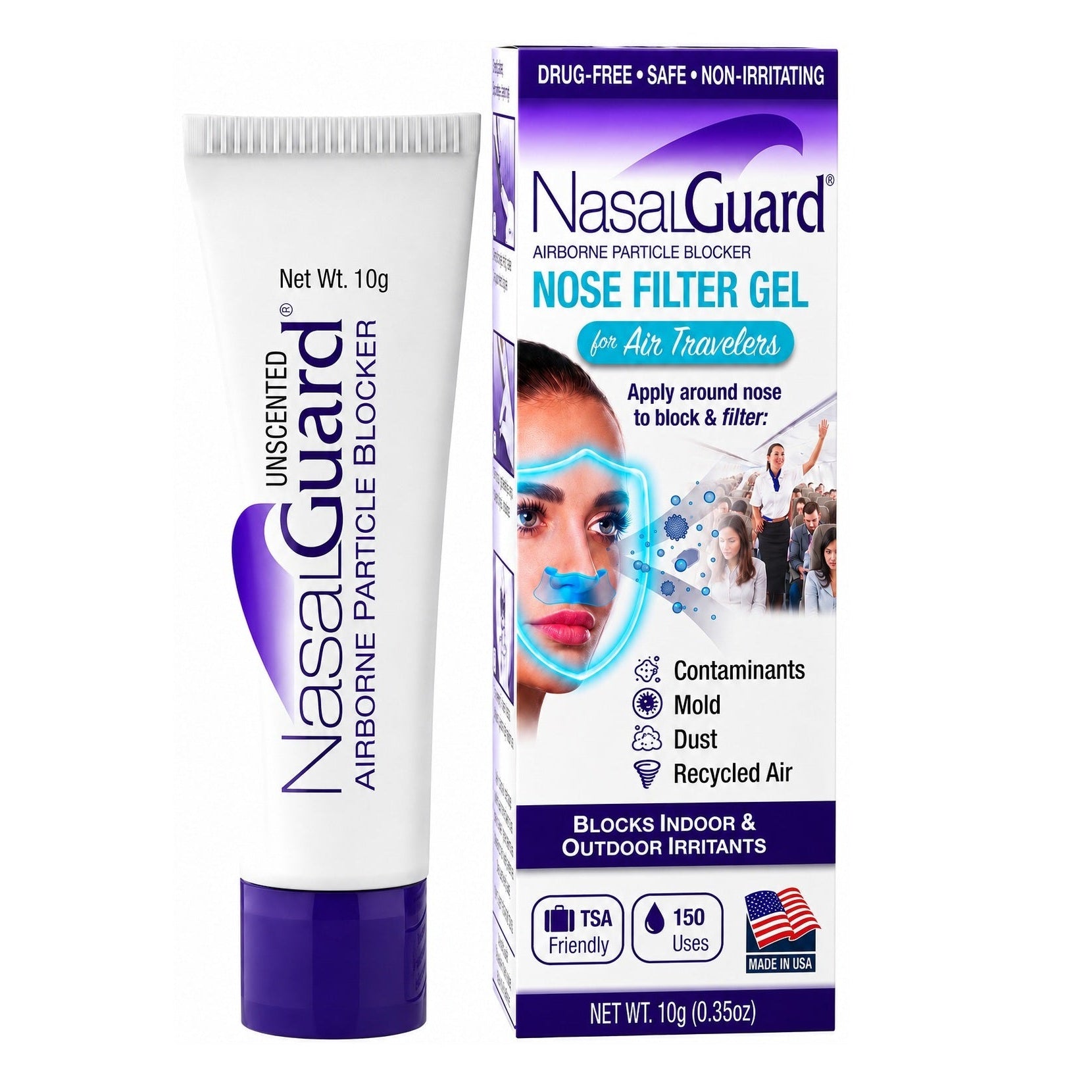
Some people also add a personal barrier step on dusty days. NasalGuard® Airborne Particle Blocker is an invisible, drug-free gel applied around the outside of the nostrils and above the upper lip to help reduce inhalation of everyday airborne particles such as pollen, dust, and pet dander. Pollen & Dust Block Unscented is the everyday version. Use it as directed.
Frequently asked questions
Why can I see dust in sunlight but not in the rest of the room?
Dust floats throughout the room, but you only notice it where bright light hits it. In a sunbeam, each speck scatters some light toward your eyes and stands out against the dimmer room behind it. Outside the beam, the same particles get too little light to stand out, so the air looks empty even though particles are still there.
What are the dust particles in the air at home made of?
Indoor dust can contain outdoor soil and dust tracked or blown inside, pollen, pet dander, human skin flakes and hair, and particles from cooking, cleaning, candles, and household products among the things indoor dust may contain. The exact mix depends on the home, the people and pets in it, and the season.
Can you see PM2.5 in a sunbeam?
Not as individual specks. Fine particles are 2.5 micrometers and smaller and are often compared with a human hair, about 70 micrometers wide. It notes that some particles can only be detected with an electron microscope. The specks you can pick out one by one in a sunbeam are larger particles, so a beam can't tell you how much fine particulate matter is in the air.
How long does dust stay in the air?
It depends on particle size and air movement. NOAA notes that in the open atmosphere, very fine dust can stay aloft for 20 days or more, while larger dust particles usually fall within 24 hours. Indoors, drafts and everyday movement matter more, and walking, cleaning, and vacuuming can kick settled dust back into the air.
How do I keep dust from swirling when I clean?
Use a damp cloth instead of a dry one, since dampening the cloth helps keep settled dust from going back into the air. Vacuum weekly or more often, change filters on the manufacturer's schedule, and shake throws and rugs outdoors rather than inside the room.
Tomorrow afternoon, when the sun drops into that window again, run the four-step check before you start cleaning. Swap the dry duster for a damp cloth on whichever surface lit up the beam the most, then look at the same window the next day.
Christine Walek writes for the NasalGuard editorial team about air quality, travel, and the everyday airborne particles we share space with. Articles are reviewed against current product labeling before publishing.